
Miscellaneous
Can Music Make You Smarter?
"The Mozart Effect"
A growing body of research is showing that early exposure to music enhances a child's brain development, improving everything form math to language skills. A study at the University of California at Irvine, for example, indicates that early childhood music study improves spatial reasoning. Children in the study who had taken music lessons dramatically improved their ability to draw geometric figures, copy patterns of colored blocks and work mazes. Furthermore, they showed a 46 percent increase in their spatial IQ, which is important to higher brain functions such as mathematics.
There is conclusive evidence that youngsters who have studied music for four or more years through high school fare significantly better on the SAT than their peers. Students with a musical background score 51 points higher on the verbal part of the SAT and 39 points higher on the math portion than students with no musical training.
Merely listening to music may have a beneficial effect. A study at the University of California at Irvine suggested that listening to music might somehow enhance the brain's ability to perform abstract operations immediately afterward. The study found that college students who listened to Mozart's Piano Sonata K448 for 10 minutes scored eight points higher on a special IQ test than those who did not listen to it.
The phenomenon has come to be known as the "Mozart Effect," although the researchers suspect that listening to any complex musical piece would produce similar results.
"South Florida Parenting"
- January 1997
"Math and Logic"
At UC Irvine, Gordon Shaw suspected that all higher-order thinking is characterized by similar patterns of neuron firing. After eight months (of music lessons), the researchers found, the children 'dramatically improved in spatial reasoning,' compared with children given no music lessons, as shown in their ability to work mazes, draw geometric figures and copy patterns of two-color blocks. Shaw suspects that when children exercise cortical neurons by listening to classical music, they are also strengthening circuits used for mathematics. Music, says the UC team, 'excites the inherent brain patterns and enhances in complex reasoning tasks.'
The Musical Brain
Skill: Music
What we know:
- String Players have a large area of their sensory cortex dedicated to to fingering digits on their left hand.
- Sing songs with children. Play structured melodic music. If a child shows any musical aptitude or interest, get an instrument into her hand early.
"Newsweek" - February 19, 1996

Correa: Preparatory Scales for Violin
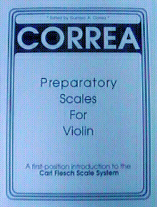
For more information about violin lessons, please click on the links on the left side of this page.
Call to schedule Boca Raton violin lessons, or lessons in the surrounding area:
(561) 213-9101
